Is Your Fluffy Just Getting Old… Or Are They Trying to Tell You Something?
As our fluffies get older, it’s easy to put changes down to one thing:
“They’re just getting old.”
They’re slower getting out of bed. They don’t jump onto the couch quite as easily. Walks become shorter. They sleep more. Maybe they’re a little grumpier when touched.
Some changes are, of course, part of ageing. But at KIBO Holistic Vet Team, we don’t believe everything should automatically be dismissed because an animal is getting older.
Sometimes those little changes are their way of telling us something.
7 signs worth paying attention to
Your senior fluffy may need a little more support if you notice:
Taking longer to stand up after sleeping
Hesitating before using stairs or jumping into the car
Limping or stiffness, particularly after rest
Sleeping considerably more or becoming less interested in walks
Becoming grumpy or sensitive when certain areas are touched
Changes in appetite, digestion, thirst or toileting
Simply seeming less like themselves
One small change may not mean very much. But when several start appearing together, it’s worth looking at the bigger picture.
TCVM looks beyond the symptom
Traditional Chinese Veterinary Medicine (TCVM) takes a different approach to the ageing animal.
Rather than looking only at the sore hip, stiff knee or lack of energy, we consider the whole fluffy.
Dr KK looks at their mobility, appetite, digestion, thirst, sleep, energy, behaviour, temperature preferences and overall constitution to identify their individual TCVM pattern.
Why?
Because two 13-year-old dogs with arthritis may have the same conventional diagnosis but, from a TCVM perspective, be very different patients.
And that means their treatment may be different too.
Meet Loki
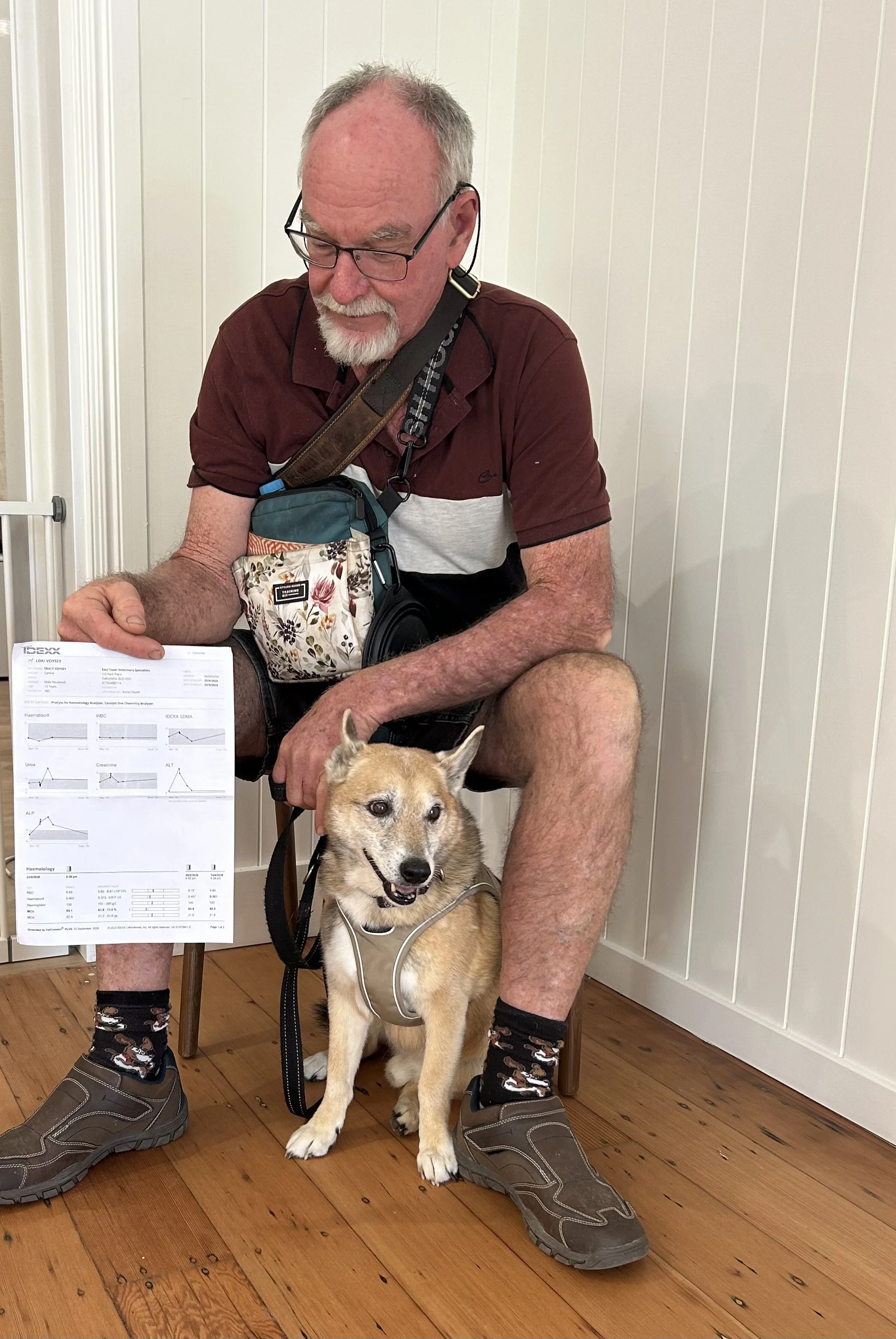
Loki is a great example.
At 13 years young, Loki came to KIBO with severe arthritis, sore hips and knees, limping and very high liver enzymes.
His family noticed that his discomfort was affecting more than just his walking — he could also be pretty grumpy when he was sore.
From a TCVM perspective, Dr KK identified Loki's pattern as Liver Damp Heat with Kidney Deficiency and local Blood and Qi Stagnation.
His individual treatment plan has included acupuncture, Chinese herbal medicine and food therapy.
And his family's description of the change makes us smile:
“He used to walk like a 100-year-old man, but now he’s more like a 60-year-old, with very minimal limping or none!”
His liver enzyme levels have also come down considerably while under veterinary care.
Loki is still 13. We haven't magically made him young again.
The aim is to help him feel and function as well as possible at the age he is.
Supporting the senior fluffy
Depending on the individual animal, a TCVM treatment plan may include acupuncture, Chinese herbal medicine, food therapy, Tuina or Microcurrent Point Stimulation (MPS).
Treatment isn't about applying the same solution to every older dog or cat.
It's about asking: What does this particular animal need?
For one fluffy, mobility may be the biggest concern. For another, it might be digestion, appetite, energy or general comfort. Often, several things are happening at once.
And TCVM doesn't have to replace conventional veterinary care. Blood tests, imaging, medication and conventional diagnosis can be extremely important, particularly when a new change appears in an older animal.
The two approaches can work alongside each other.
Don’t automatically blame age
Perhaps the most important thing we can tell families with senior fluffies is this:
Getting older is normal. A significant change in how your animal feels or behaves deserves attention.
If your fluffy has stopped doing something they used to enjoy, is struggling to move comfortably, has changed their eating or drinking habits, or simply doesn't seem like themselves anymore, don't automatically assume:
“They're just getting old.”
They may be telling you something.
And sometimes, with the right support, our old fluffies can surprise us with just how much life they still have in them.
KIBO Holistic Vet Team
Traditional Chinese Veterinary Medicine • Acupuncture • Chinese Herbal Medicine • Food Therapy • Tuina • MPS